DomainDrift: verifiable internet telemetry
Editor's note: this post is from 2026-07-12 and its scale figures are left as written. The catalog has grown a great deal since; look up any domain and see its current coverage at domaindrift.io.
DomainDrift watches around 50,000 domains on a loop and signs every observation. When a domain's DNS, host, email posture, or certificate moves, the change is the event: what it was, what it became, and when we saw it.
The internet's configuration moves constantly, and it moves silently. DomainDrift turns those silent moves into a record you can search, watch, and hand to someone else as evidence.
The change is the event
A nameserver that moved is how a hijack starts. A certificate that reissued off schedule is how impersonation starts. A mail record that weakened is how spoofed invoices start. A host that went dark is how an outage announcement starts, and you want to be the one making it, not receiving it.
DomainDrift records each of these as a first-class event with a before, an after, and a timestamp. You never have to wonder whether something changed: the record says what changed, and when. If you run a portfolio, watch your vendors, track competitors, or answer to clients for infrastructure you do not control, this is the feed you check in the morning.
What a scan sees
Each pass sweeps the full catalog roughly every 21 hours and records every plane that matters operationally: DNS across nine record types, TLS from certificate transparency, WHOIS over RDAP, ASN, DNSSEC, and robots.txt. The methodology documents exactly what it touches and what it never does. It is not a crawler, and it never reads page content.
Evidence, not screenshots
Every observation carries an Ed25519 receipt written the moment it is made, and receipts verify in your browser against published keys. When you need to show a registrar, a client, or an auditor that a record changed on a specific day, you are not sending a screenshot. You are sending a signed observation they can check themselves.
Take a look
Search a domain at domaindrift.io, open its page, and see what is steady and what has moved.
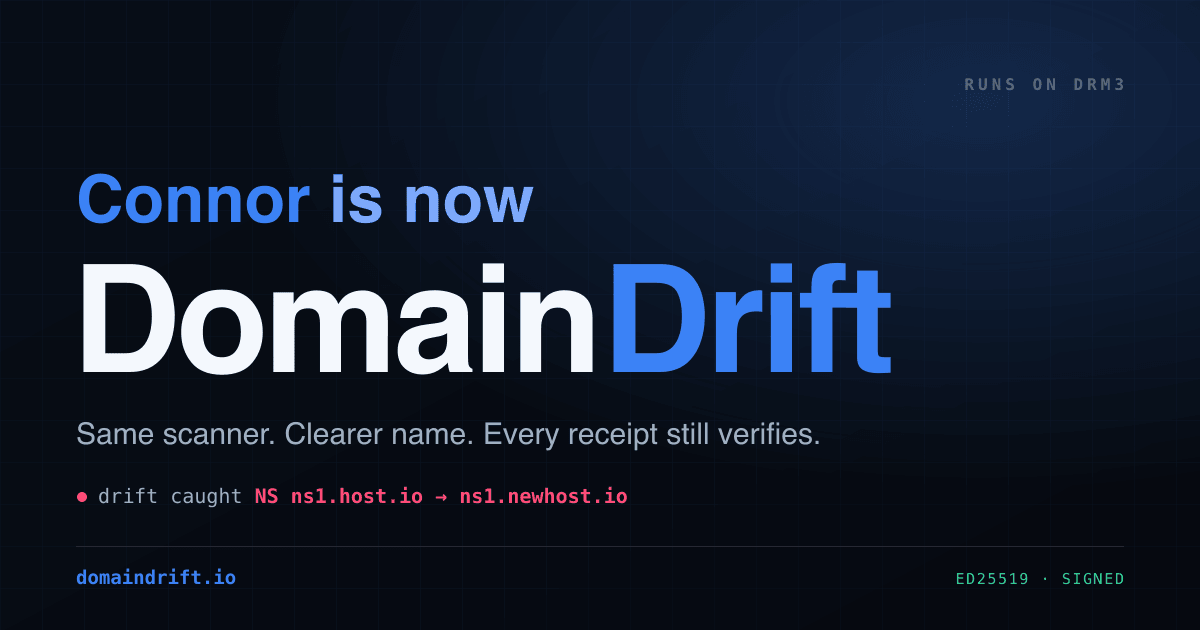
Formerly Connor. Old links redirect, and every receipt ever issued still verifies.
Published by
Robert Christian
Founder and CEO, DRM3 Labs Corp.
More from DRM3 Labs
How to trust the data your AI agent uses
Robert Christian · 4 min read
Data with receipts: what a provenance receipt proves, and what it cannot
Robert Christian · 4 min read
A pre-flight checklist for feeding data to a model
Robert Christian · 3 min read