
Pistachio v0.19: direct chain reads, canaries
Who should upgrade
Everyone on v0.18 or earlier. Pistachio reads chain data directly, so session state comes from one source. Desktop users get in-browser RPC setup.
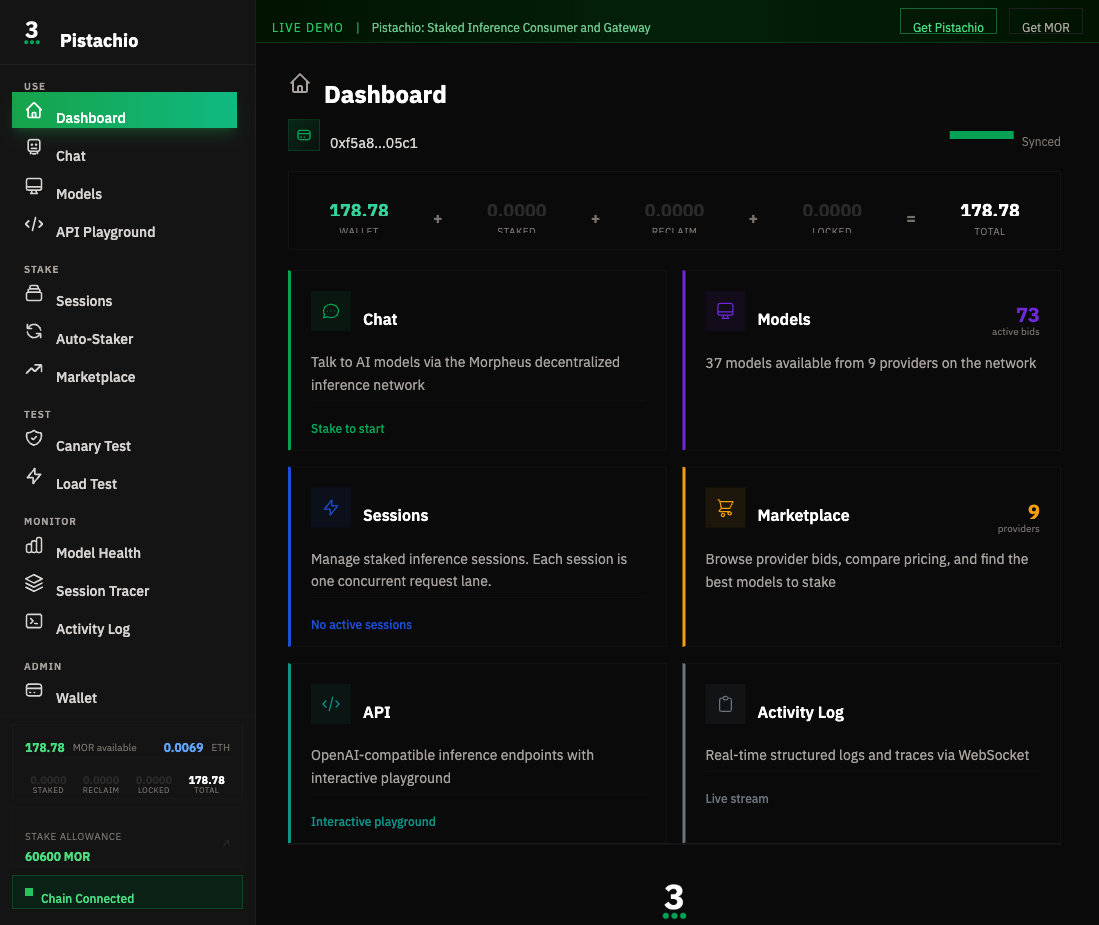
Pistachio v0.19. Pistachio now reads all data directly from Base chain contracts, no longer depends on Cashew, and includes canary testing, load testing, model blacklists, signed capacity verification, RPC setup for desktop users, and clear error attribution.
Pistachio is an inference client for the Morpheus decentralized AI network. It stakes MOR tokens on Base, opens sessions directly with providers, routes inference, and exposes an OpenAI-compatible API on localhost.
Alpha software. Pistachio is closed source and requires a wallet private key for on-chain transaction signing. There are no warranties, expressed or implied. Use at your own risk. MOR staking involves real tokens on Base mainnet. DRM3 Labs Corp. is not responsible for any loss of funds, failed transactions, or service interruptions.
RPC setup for desktop users
The desktop app now guides first-time users through RPC configuration in the browser. Previously, if you installed the desktop app without a Base RPC endpoint, the server refused to start and you hit a dead 'connection failed' screen with no way forward.
Now Pistachio starts in a setup mode: the UI loads, shows a clean RPC configuration screen with Alchemy setup instructions, a test button, and a save-and-restart flow. No terminal commands needed. This was the number one blocker for new desktop users.
Pistachio vs Provider errors
Error messages in chat now clearly indicate whether the error came from Pistachio (our timeout, our capacity issue) or the provider (did not respond, TCP failure, decrypt error). Previously, a generic 'request timed out' gave you no idea where the problem was.
Structured logs carry the same source field, so you can filter by Pistachio errors versus provider errors in the Activity Log. When a provider is consistently failing, you know it is the provider and not your setup.
Session close serialization
When multiple sessions expire at once, close operations now queue sequentially instead of firing in parallel. This eliminates the 'another close already running' errors that appeared when the canary test cleaned up after a sweep. Your MOR still comes back; it just happens without a wall of red error cards.
Homebrew cask rename
The Homebrew cask has been renamed from `pistachio` to `pistachio-desktop`. A new CLI-only formula (`brew install pistachio`) is available for headless servers. Both can coexist. The desktop app puts both `pistachio` and `pistachio-desktop` on your PATH.
Direct chain reads
Pistachio reads all Morpheus network data directly from Base chain contracts via RPC. Sessions, marketplace bids, provider listings, and wallet balances come straight from the smart contracts. No intermediary, no shared database, no relay.
NFT pass capacity is checked through the DRM3 Explorer, which reads from the DRM3 Pass contract on Base. That capacity response is cryptographically signed and verified (see below).
Pistachio boots from zero with a wallet key and a Base RPC endpoint. Free public RPCs are cycled automatically with failover.
Signed capacity verification
Every NFT capacity response from the DRM3 Explorer is signed with Ed25519 using the DRM3 provenance protocol. Pistachio verifies the signature against a pinned public key, validates the wallet address in the input hash, and enforces a five-minute freshness window.
If the response is unsigned, tampered with, signed by the wrong key, or stale, Pistachio rejects it and falls back to its cached value.
Canary testing
The Canary Test page fires a single inference request at every provider and model combination on the network. Per-stage latency (TCP handshake versus prompt delivery) shows which models respond and which providers are degraded.
Results feed into the Model Health dashboard.
Load testing
Built-in stress testing with configurable concurrency, request counts, and load presets. Per-request traces for every success and failure. The Model Health dashboard aggregates results across canary sweeps, load tests, and chat sessions.
Model blacklist
Persistently exclude models that do not work. Blocked models are hidden from inference, canary tests, and load tests. Managed from Settings with a per-provider view and health indicators.
Parallel session reclaim
Expired session reclaims now run concurrently. A batch of 60 sessions completes in under three seconds.
DeepSeek V4 Pro and Kimi K2.6
Two notable model additions on the Morpheus network. DeepSeek V4 Pro (reasoning and code generation, available as base and web-search variants) and Kimi K2.6 from Moonshot AI (multilingual, web search). Both available through the marketplace.
Pistachio Pass GEN 9
The DRM3 Pass NFT contract redeployed to GEN 9 on Base mainnet. Existing pass holders are auto-airdropped at each generation roll. Capacity tiers: Free (20 MOR), Bronze (+200), Silver (+1,000), Gold (+5,000), Diamond (+20,000). Claim a free pass at nft.drm3.xyz.
Install or upgrade
Desktop app users will receive an auto-update prompt on next launch. Full documentation at drm3.io/products/pistachio. Release notes and binaries at github.com/drm3labs/drm3-releases.
Alpha software. Pistachio is closed source and requires a wallet private key for on-chain transaction signing. Provided "as is" without warranty of any kind. Use at your own risk. MOR staking involves real tokens on Base mainnet. DRM3 Labs Corp. is not responsible for any loss of funds, failed transactions, or service interruptions.
brew tap drm3labs/drm3 && brew install --cask pistachio-desktopbrew tap drm3labs/drm3 && brew install pistachiocurl -fsSL https://drm3.network/install.sh | shbrew upgrade --cask pistachio-desktopDisclosure: DRM3 Labs holds and stakes MOR and sells MOR-denominated products.
Published by
Robert Christian
Founder and CEO, DRM3 Labs Corp.
More from DRM3 Labs
How to trust the data your AI agent uses
Robert Christian · 4 min read
Data with receipts: what a provenance receipt proves, and what it cannot
Robert Christian · 4 min read
A pre-flight checklist for feeding data to a model
Robert Christian · 3 min read
2026 DRM3 Labs Corp. All rights reserved. DRM3 Labs builds infrastructure for open protocols.
This article is for informational purposes only. Nothing here is financial, investment, or legal advice. Tokens, staking, NFTs, and blockchain protocols are described as technical mechanisms, not investment recommendations. Digital assets carry risk. References to the Morpheus network describe the public protocol as documented at mor.org.