
Pistachio
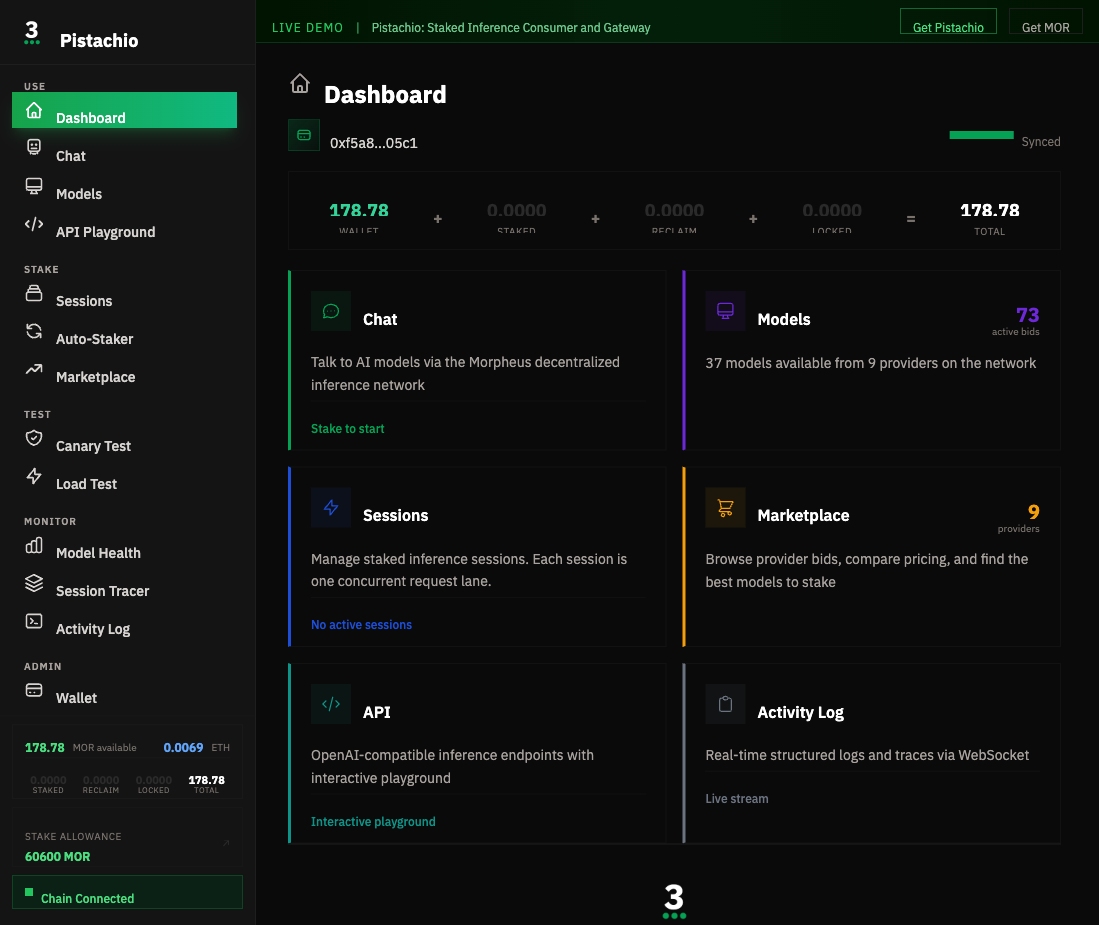
A downloadable AI inference client for the Morpheus decentralized network. Run it yourself on your machine or your own server, no vendor lock-in, direct peer-to-peer connections to compute providers. There is no DRM3-hosted demo; you self-host.
- Access
- Public
- State
- Live
- Family
- App
- Tier
- Application
Morpheus is a decentralized peer-to-peer AI network where independent compute providers run models and register on-chain. The default gateway routes through a third-party broker who adds latency, takes a cut, and becomes a single point of failure. Pistachio removes that broker entirely. Your machine connects directly to the provider. One less hop, no middleman, no markup.
MOR staking is collateral, not payment. It returns in full when sessions close. The only real cost is a small amount of ETH gas on Base. Providers compete on price and uptime. You pick the model, Pistachio finds the best available provider.
Permissionless inference matters. No vendor approval, no API waitlists, no terms that change overnight. For open data processing at scale, that independence is the point. DRM3 runs millions of articles per year through AI analysis on this infrastructure. The same network is available to anyone running Pistachio.
OpenAI and Anthropic-compatible APIs on localhost. Drop it into any existing workflow. Auto-staking, auto-renewal, zero downtime. Available as a Docker image to run your own gateway on any container host. Total cost: roughly $5 to $8 per month for the container, plus whatever MOR you stake for capacity.
Screenshots
Capabilities
Permissionless: no vendor approval, no API waitlists, no terms that change overnight
Peer-to-peer: your machine connects directly to compute providers
Zero capex: providers supply the compute, MOR collateral returns when sessions close
No broker markup: one less hop, lower latency, better economics
OpenAI + Anthropic API compatibility on localhost
Docker image to run your own gateway ($5-8/mo self-hosted)
MOR staking with automatic session renewal
NFT-gated access tiers (Free through Diamond): contracts deployed, program paused
Multi-provider routing with health monitoring
Ed25519 provenance signing on every response