The inference inflection: agents and MOR
AI infrastructure spending shifted noticeably toward inference this quarter. Dell pivoted its growth thesis from GPUs to CPUs. AMD positioned its entire roadmap around inference and agentic AI. Intel and SambaNova announced heterogeneous stacks that split prefill, decode, and agent actions across specialized silicon. Tech giants committed $725 billion in AI infrastructure capex this year alone. [1] [2] [3] [4]
Inference demand is growing. The open question is how it gets served.
Important: Pistachio is closed-source alpha software. It requires a wallet private key for on-chain signing, which means you are trusting the binary with key material. There are no warranties, expressed or implied. Use at your own risk. MOR staking involves real tokens on Base mainnet. DRM3 Labs Corp. is not responsible for any loss of funds.
Agents changed the math
A chatbot is one user, one question, one inference call. An autonomous agent is one operator, zero questions, hundreds of inference calls per hour.
Nous Research shipped Hermes in February. It is an autonomous agent that lives on a server, remembers what it learns across sessions, builds skills from experience, and runs unattended. It connects to twenty messaging platforms. It schedules its own jobs. It spawns subagents in parallel. It does not sleep.
And it is provider-agnostic by design. Hermes connects to any OpenAI-compatible endpoint. Morpheus exposes exactly that. One config change and every inference call routes through the decentralized network.
Every tick is an inference call. Every inference call is MOR consumed. Multiply that by operators running automated decision loops [5] on infrastructure no single entity controls, and the usage pattern looks more like infrastructure than speculation.
75% of Americans already want this
This is not a fringe position. A Harris Poll of 2,036 Americans conducted for DCG found that 75% believe decentralized AI is more likely to support innovation than centralized AI. 71% see it as more secure for personal data. 88% say they should have more control over how their data is used by AI systems.
86% of respondents already see AI benefits in their daily lives. The question is whether they want it controlled by a handful of companies or distributed across an open network. Three out of four chose open.
That is the demand signal. Morpheus is building the supply side. Pistachio makes it usable.
The supply side is straining
Centralized AI APIs are raising prices. Capacity is constrained. CPU prices are up 10-20% with 12-week lead times [6] as chipmakers prioritize data centers. RAM and SSD prices are warping [7] under data center demand. Multi-agent workloads are shifting compute profiles [8] away from what GPU farms were built to serve.
The arbitrage window for decentralized inference is widening. Idle silicon exists everywhere. Morpheus lets anyone with a GPU serve models and earn MOR emissions. The providers are paid by the protocol, not by the user. Your MOR is capital you stake for the duration of a session, not a fee. It comes back when the session closes. Capex, not opex.
Morpheus AI community leader Ryan Condron put it simply: 90 MOR at current prices gives you roughly $1/day of perpetual compute. That is what staking 90 MOR on the network yields in continuous inference capacity.
When centralized prices rise and decentralized supply scales, the arbitrage gets larger. That is the macro condition where Morpheus has its strongest argument.
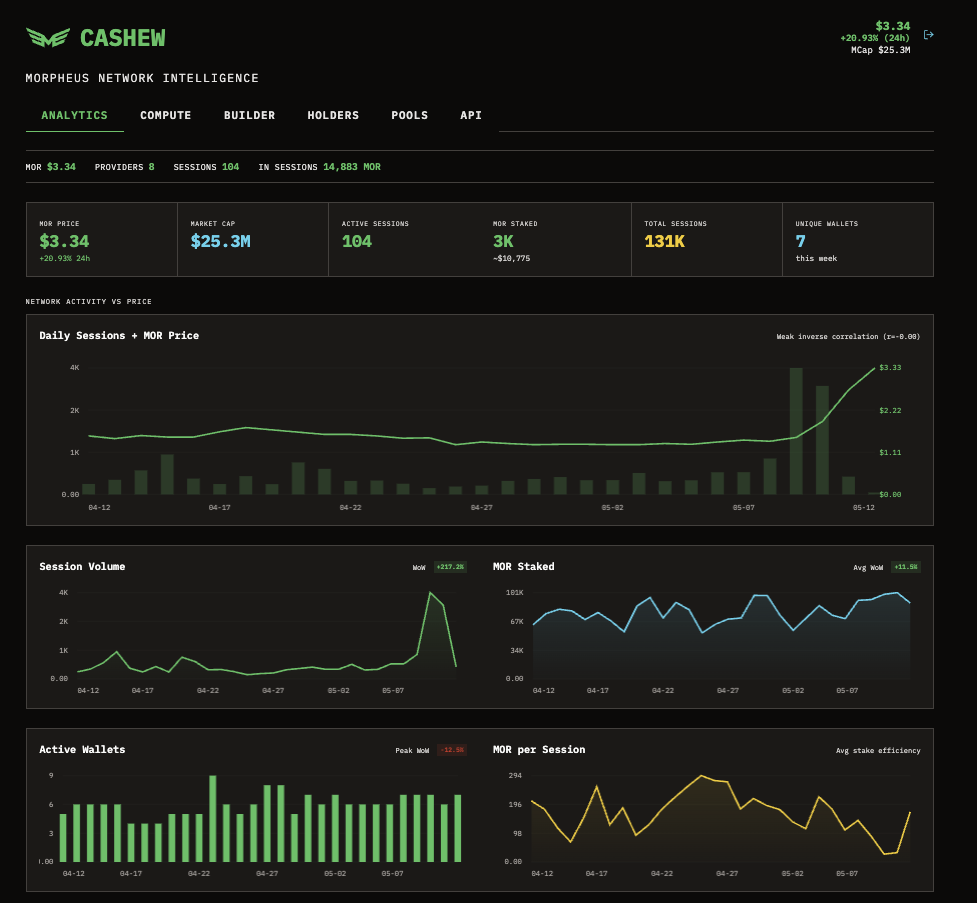
The numbers are visible on Cashew, the Morpheus network intelligence dashboard built by DRM3. Session volume is up 217% month over month. 104 active sessions. 131K total. 14,883 MOR in sessions.
Where Pistachio fits
Decentralized compute needs a usability layer. Raw provider access is not enough for production use.
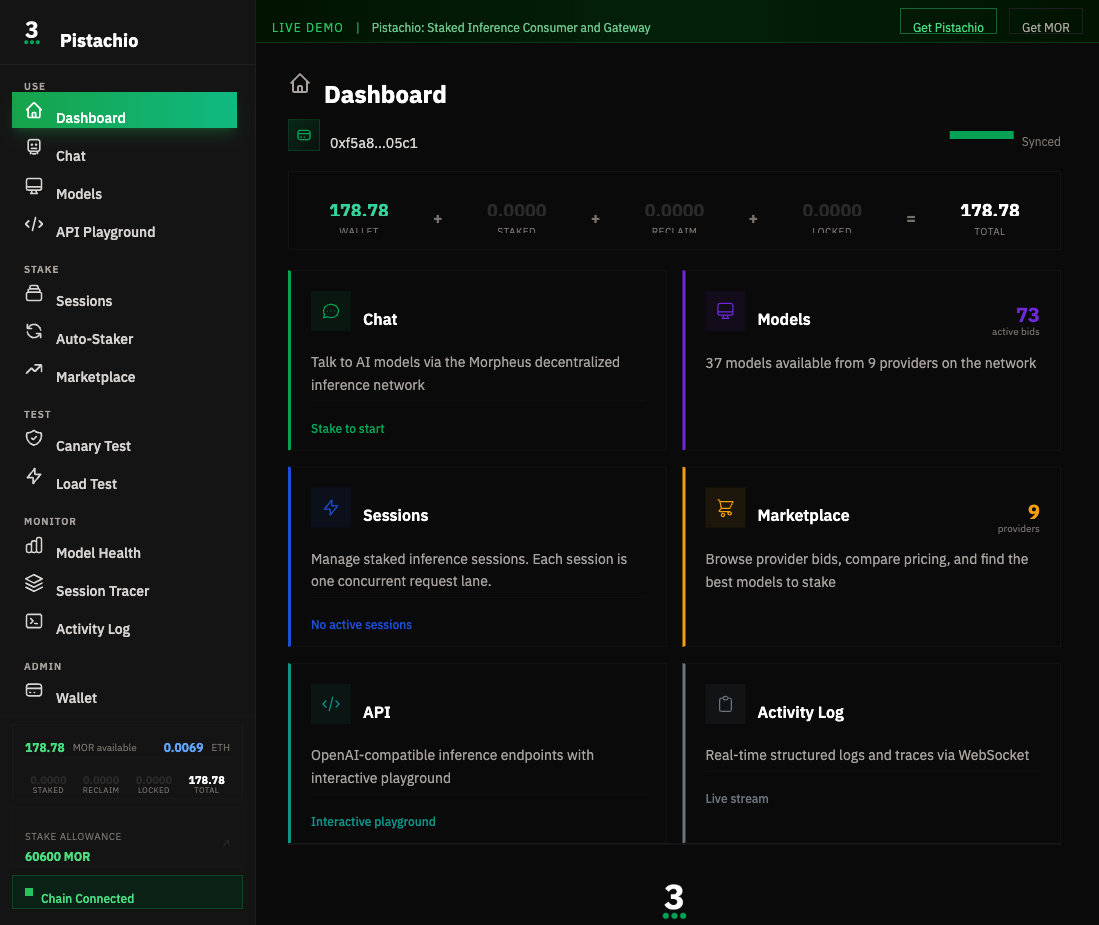
Pistachio refines it. The router selects providers per request based on availability, latency, model match, and the user's NFT tier. The queue absorbs backend variance so a flaky Morpheus session does not surface as a flaky user experience. The blacklist kills misbehaving models in a click. Sessions trace cleanly so when something goes wrong the diagnosis takes seconds.
The canary test sweeps the entire network and tells you which models actually respond before you stake a single MOR. The load test hammers your staked sessions to verify throughput under pressure. The model health dashboard aggregates everything into a reliability view across 67 models from 9 providers.
That is the operator layer that makes decentralized inference practical for daily use.
The receipts close the loop
Inference was the part of the data pipeline where the receipts ran out. You could attest the inputs going in. You could attest the outputs coming out. But the act of inference happened in someone else's black box.
Pistachio closes that gap. The session is opened by your local gateway. The provider is selected by your router. The response is Ed25519-signed at the edge before it touches anything else. The NFT capacity check is now cryptographically verified. The attestation chain that runs from source through aggregation and synthesis now includes the inference itself.
For Hermes operators this is the upgrade that matters. An autonomous agent running unattended for weeks generates thousands of inference calls. Without receipts, that is a black box that occasionally writes things to disk. With receipts, it is an auditable workstream. You can prove what your agent saw, what it inferred, and what it produced.
What is actually happening
Agents drive demand for inference. Morpheus supplies it. MOR is the meter. Pistachio is the gateway that makes the supply usable. DRM3 signs the whole chain.
That is the loop. That is the current state of the system.
Free to start. NFT passes for additional capacity. 67 models including DeepSeek V4 Pro and Kimi K2.6. Every response provenance-signed. Install in one line.
Agent-based systems are already deployed and driving steady demand.
Want to dig into the source material? Search the record at truthfoundry.ai for 'ai inference demand.' 50+ articles from Latent.Space, Seeking Alpha, Bloomberg, and Habr. All provenance-signed.
Pistachio is free to start. Install in one line.
Alpha software. Pistachio is closed source and requires a wallet private key for on-chain transaction signing. There are no warranties, expressed or implied. Use at your own risk. MOR staking involves real tokens on Base mainnet. DRM3 Labs Corp. is not responsible for any loss of funds, failed transactions, or service interruptions.
Disclosure: DRM3 Labs holds and stakes MOR and sells MOR-denominated products.
Sources
- [1]Dell's AI Moment: Why Inference and CPUs Are Driving the Next Growth Cycle ↩
- [2]AMD: Inference and Agentic AI Are Expanding Its Runway ↩
- [3]Intel Earnings Driven by AI CPU Demand Shift ↩
- [4]Tech Giants Report Surging AI Spending Amid Explosive Demand ↩
- [5]Close the Loop: AI Agents and Automated Decision Making ↩
- [6]AI Demand Drives Global CPU Price Hikes and Supply Shortages ↩
- [7]AI Demand Drives Sharp Rise in SSD and RAM Prices ↩
- [8]AI Inference Demand Explodes, Driving CPU Shortage and Platform Shifts ↩
Published by
Robert Christian
Founder and CEO, DRM3 Labs Corp.
More from DRM3 Labs
How to trust the data your AI agent uses
Robert Christian · 4 min read
Data with receipts: what a provenance receipt proves, and what it cannot
Robert Christian · 4 min read
A pre-flight checklist for feeding data to a model
Robert Christian · 3 min read
2026 DRM3 Labs Corp. All rights reserved. DRM3 Labs builds infrastructure for open protocols.
This article is for informational purposes only. Nothing here is financial, investment, or legal advice. Tokens, staking, NFTs, and blockchain protocols are described as technical mechanisms, not investment recommendations. Digital assets carry risk. References to the Morpheus network describe the public protocol as documented at mor.org.